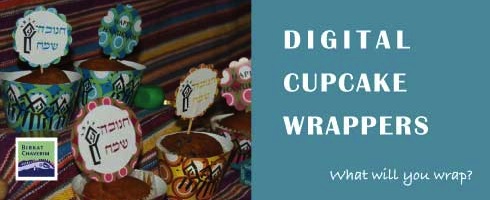
Tomorrow is my daughter’s last day in gan for the year and today is her end of the year party. We decided to give the four teachers gifts each one gift from the whole gan. Part of the gift is something returnable and part of it is something from the children.
I asked all the parents to send a photo of their child and a quote “What is your favorite thing about gan?” Its a good thing I asked for this a few weeks in advanced, because the main gannenet (pre-school teacher) asked for quotes for the other gannenot and it might have been difficult to get the materials we needed given the additional requests. Continue reading »
The title probably should be something like “Taking advantage of Melabev’s book launch to talk about Bar and Bat Mitzvah activities.”
To give a brief overview- Melabev is a community center(s) for people with dementia. They have programs for early stage dementia patients to both have ongoing mental stimulation and provide respite for their families. They have many different programs, including memory clubs and have programs in several languages.
On June 30th, those of you who live in the central area of Israel might be interested in coming to the book launch for “Alzheimer and other Dementias. Treating and Coping with Mentally Frail in the Community” (Hebrew.) There are all types of articles related to the care of people with early and late stages of dementia as well as articles on supporting families and even spiritual care of dementia patients. The book launch with be at Melabev June 30 7:30, Derech Beit Lechem 152. For details contact 052 7203025.
Disclosure- my sister edited the book and contributed several articles, including “Intergenerational activities-young people and dementia patients.” Which relates to an activity that could be done for Bar and Bat Mitzvot. Melabev welcomes young celebrants who wish to celebrate their Bar/Bat Mitzvah with center participants. Its fun for people who attend the centers and a good learning experience and chesed opportunity for children and their families.
For more information you can be in touch with Melabev via their website or contact me and I’ll make sure they get your questions.
Making Bat Mitzvah’s (and Bar Mitzvahs) meaningful and fun is often a topic of discussion between parents and children. There are many different things that can be done (and i blogged about a great resource here.)
but here are a few other ideas:
Hafrashat Challah (separating challah) is a big one for Bat Mitzvahs. As one of the three prominent mitzvot for women as mentioned in the mishnah (of which one is sort of irrelevant for twelve year old girls in contemporary society), its an easy way to acknowledge a girls acceptance of mitzvot and you end up with something yummy. Two of my nieces did this as part of their Bat mitzvah celebrations, one of them as part of a program with Melabev, a day care center for people with dementia. This could include decorating challah seperating tefillot cards with a card shaped like a challah, a magnet and the text of the tefillot.
Several of the girls in my chug have also been making family scrapbooks as part of their Bat mitzvah activities. They learn more about their families as well as a new skill. In a simplified form, scrapbooking could be done as an activity at a bat mitzvah celebration by asking participants to bring family photos and coming up with an interesting question to answer as part of a scrapbook page layout. it could be holiday, story or event centered as well.
Here’s another idea which is completely different. Cake, cookie or cupcake decorating. You could do this as an opportunity to learn how to frost and decorate cupcakes (here’s an example of a party of that type here.
My niece recently did a variation on this but using edible paper toppers which could be decorated with edible ink pens. Each girl could draw on the paper and transfer the design to the cupcake. Papers and pens with kosher certification include Kopykak’s frosting sheets.
Here are some results:
There are also many programs today that have mother daughter learning opportunities. Check locally for what is available.
If you are looking for a project for a Bat Mitzvah around Shavuot, you could try floral arrangements with old nylons. Nylons can be dyed using store bought dye or food coloring and vinegar. There are a variety of examples on the web for inspiration and tutorials, or you can get a copy of The Art of Handmade Flowers.
For online tutorials and examples of nylon floral arrangements see:
One idea for a Bar or Bat Mitzvah is to learn about the Haggadah and create your own commentary and illustrations. A useful resource for this is the Open Source Haggadah project. Although the project is officially over, the website still provides access to the Haggadah text as well as extra resources that may be useful in creating ones own haggadah.
Updated: I just noticed that Graphos has a special promotion for Pesach. You can create your own Haggadah with your own pictures. They have a one free per family promotion. The coupon code, 4701C20333 is good through March 15, 2010.
Adar means Purim and Purim means megilla, seuda, and mishloach manot. Mishloach Manot, of course, require containers to hold them in and that’s what this post is about. The hand made sort of course. Continue reading »
This weeks parsha is one of the places where the concept of sanctifying the first born comes up. Many years ago I was excited to have an opportunity to go to my first Pidyon Haben (although ironically I ended up being able to attend three over a period of about three months.) Because I was studying Jewish art, I knew that the platter the baby is placed on, was in the past decorated with the Zodiac and Akedat Yitzchak (sacrifice of Isaac.)
I decided to make a Zodiac pillow case, but with a little humour since it was intended for a family who liked (and still like) penguins. The text included is the first verse in this weeks parsha and some text from the Pidyon HaBen ceremony.
Pidyon Haben’s are not so common, I don’t remember any particular customs from the three that I attended. However, a recent Pidyon Haben in the family has revealed some Chasidish customs which include draping the baby in jewellery and serving garlic and sugar. Sugar apparently is a segula for something or other. I’m guessing that the drapping the baby in jewellery has something to do with the fact that in the past the jewellery drapped were actually amulets. Ashkenazi and Sephardi families did attach amulets to babies in the past and I would imagine this ceremony would be one where familes would want to avoid ayin hara (evil eye.) The garlic and sugar seems to be related to having lots of guests and wanting to have enough food for everyone who wanted to participate. You didn’t really have to worry about those two foods spoiling.
Tu B’shvat is really about figuring out a date for terumot and maasrot-tithing (old fruits versus new fruits, which year they are from so the fruit could be given to the correct recipients.) In the Bnei Akiva bencher, we actually do include the blessing recited when taking terumot and maasrot, but I didn’t really want to do a post about that. Its not very crafty. I also wasn’t really interested in doing something about Tu B’shvat seders or dried fruit. Instead, I’m thinking about flowers. Before fruits become fruit they start as flowers, so there you go.
My daughter and I made pipe cleaner flowers with stockings as a very simple no sew project. We did some experimenting with coloring the stockings but mostly we used the stockings as-is.
In the chug we also seem to be focusing on flowers lately. Here is one flower barrette one of our participants made.
She chose to make this barrette after we looked at a bunch of different designs and styles online. I found a tutorial of how to make this one (and of course I’m having trouble finding it again to post a link to it now.) The idea behind this one is to make four flower shapes with six petals, fold them over and attach them in the middle. That provides the depth. This participant chose to use two colors for variety. Other floral barrettes that have been made recently include another flower made of felt, but using overlapping flowers of different sizes and a large fabric flower for a headband. I’ll post images of those soon.
Here are a few more fun things for Hanukkah/Chanukkah: The first two are in Hebrew but have a lot of pictures so for readers who don’t read Hebrew, you can get the gist of the project anyway.
How to for a fondant dreidel necklace My thanks to Tal Tsafrir from Taltalim for allowing me to include a link and use an image of the project.
Hanukkah gelt (money) is a big thing for children and really the more traditional custom (in contrast to gift giving) for this holiday. Make your own chocolate Hanukkah gelt using actual coins as guides.
For families planning Bar and Bat Mitzvah celebrations or even weddings during this time, you could actually personalize Hanukkah gelt by creating round stickers with your information, to place on the outside of the gelt. Or if you wanted to be really fancy (and if bringing food items without Kosher certification to your celebration location is not a problem,) you could make a mold for poured chocolate with names and so forth.
Here’s another Hanukkah item where you can make your own mold or buy it ready made. I love these draidel crayons. The ones depicted can be ordered through Oriental Trading Company, but you could equally make your own using a small plastic draidel as a mold.
Oil or candles are a big part of Hanukkah. A tutorial for rolled beeswax candles and other candle making can be found at Candlehelp. For oil, it would be fun to do projects related to the properties of oil and water. In particular, when getting your oil and wicks ready, adding water and food coloring below the oil.
In honor of Chanukkah, I am posting a photo of a menorah. The menorah is a very popular motif in Jewish art “then and now.” However, the menorah represents the menorah used in the Beit Hamikdash or Temple rather than the Hanukkah lamp used during Hanukkah. Note the difference in the number of lights (seven versus nine.) There are lots and lots of articles on the web that speak about iconography of the Menorah in manuscripts, synagogue mosaics etc. This menorah comes courtesy of my mom who had the opportunity to visit Uzbekistan this September. The Menorah is cut into the drainpipe of the synagogue in Tashkent. Neat, no?